
100 Years of Wyssen – The History of Wyssen Seilbahnen
100 Years of Innovation from the Bernese Oberland
Today, the name Wyssen is associated worldwide with innovative cableway systems and technical pioneering work. What began over a century ago in the Bernese Oberland has developed into an internationally active company whose products are in use in many countries. The history of Wyssen Seilbahnen is characterized by creativity, entrepreneurship, and a close connection to the mountain world.
The Beginnings: Inventive Spirit from the Mountains
The story of Wyssen does not begin in a laboratory or a large corporation, but on the steep terrain of the Bernese Oberland. Jakob Wyssen Sr. (1904–2003), born the son of a farmer, had a humble upbringing. From an early age, he developed an extraordinary combination of physical adeptness, curiosity, and inventive spirit.
His daily life was marked by hard work—in the barn, on the alp, and later in various workshops. Yet even as a young man, he sought better solutions to existing problems. He repaired tools, built his own machines, and repeatedly asked himself:
How can work be made more efficient, safer, and more sustainable?
This mindset became the foundation of what would later become the Wyssen DNA.
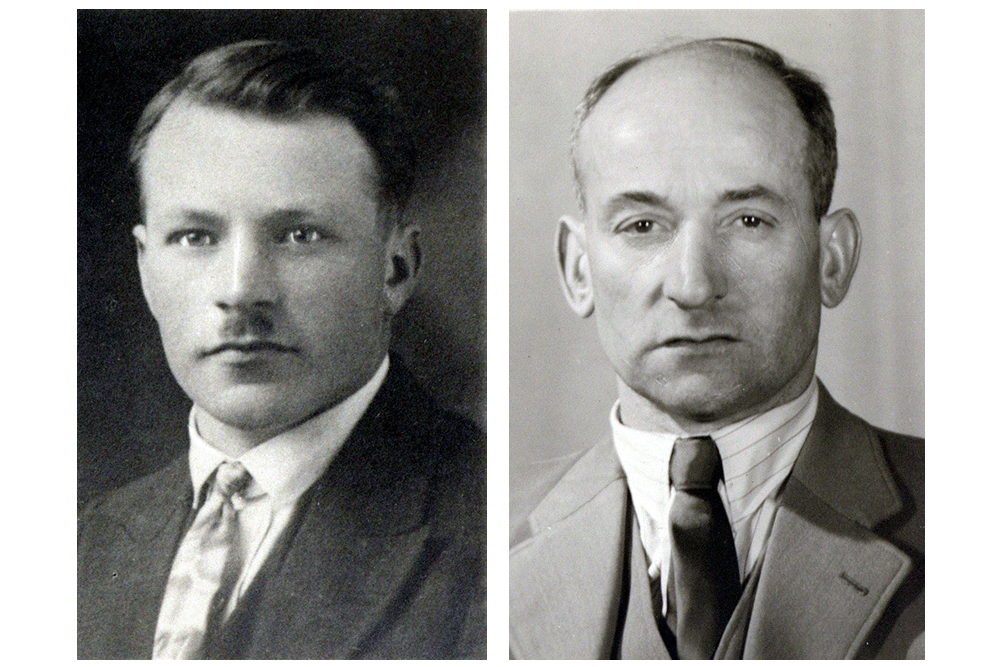
Founder Jakob Wyssen (left) and his brother Fritz Wyssen (right)

First sled winch (1928)

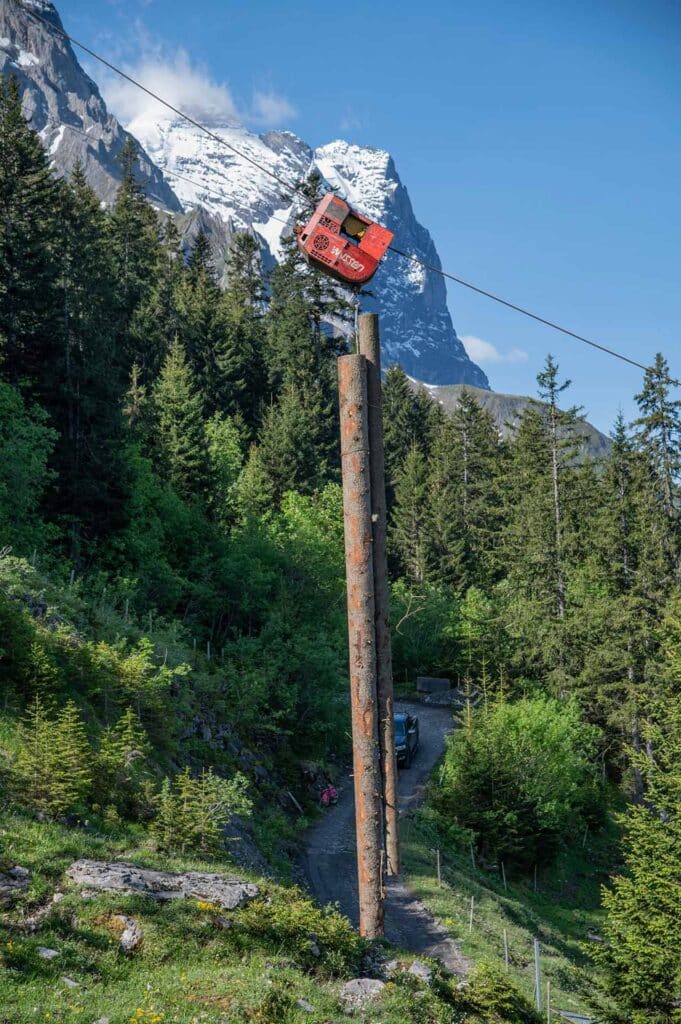
First timber transport cableway in Tschingel using a rope and a simple pulley (1930)
The Beginning: From Logging to Innovation
After holding various jobs in the timber industry, Jakob Wyssen began processing wood with a mobile sawmill in the 1920s. Together with his brother Fritz, he worked for forest owners throughout Switzerland. The work was physically demanding, and the forests were often located in steep, hard-to-reach terrain.
In 1926, he founded his own company. Just two years later, he developed the first simple cableway for timber transport.
This early solution was revolutionary:
Instead of dragging timber along the ground, it was transported through the air. This saved time, reduced damage, and significantly increased efficiency. But for Jakob Wyssen, this was just the beginning.
The Breakthrough: The Wyssen Cable Crane
In the late 1930s, the revolutionary innovation emerged: the Wyssen cable crane. The idea was as simple as it was ingenious—a carriage that not only transports timber but also actively lifts it off the ground.
The result: less damage to the timber, protection of the forest floor, and significantly higher productivity—even on extremely steep terrain.
This technology became the foundation of the company and has remained true to its original concept to this day. The semi-automatic skid developed later marked the definitive breakthrough—a true revolution for the forestry industry.
Growth in Difficult Times
World War II also presented Wyssen with major challenges. Raw materials were scarce, and the economic situation was uncertain. At the same time, the demand for wood rose sharply—for energy, construction, and industry.
Wyssen responded decisively, expanded production, took on a wide variety of contracts, and continuously refined its technology. With up to 80 employees on the job, large quantities of timber were processed and transported. This development laid the groundwork for further expansion, which reached a major milestone in 1956.
It was precisely during this period that the company’s strengths became evident: flexibility, innovation, and perseverance.
Internationalization: From Reichenbach to the World
After the war, the company began its international rise. Reconstruction in Europe and the growing demand for wood opened up new markets.
Wyssen cable cranes were soon being used worldwide—from Europe to North America, Africa, and Asia. As early as the late 1940s, the first systems were shipped to Canada and the U.S.
In the vast North American forests, the cable cranes were able to impressively demonstrate their capabilities. There, logs many times larger than those found in Europe were transported.


The Wyssen family in North America

The North American Adventure: Growth and Risk
The expansion into North America was a turning point—and a risk at the same time. In the 1950s and 60s, Jakob Wyssen traveled to the U.S. and Canada several times to tap into the market.
New dimensions of forests, different working methods, and economic pressure presented the company with major challenges. Yet the opportunities were enormous. The Wyssen family even moved to North America for a time to implement projects on-site.
This phase was crucial for the company’s further development—both technologically and entrepreneurially.
From a family business to an industrial enterprise
In the 1950s, the company headquarters was established in Reichenbach—an important step toward optimization.
The company continued to grow, expanding its mass production and engineering capabilities and establishing international sales structures. At the same time, Wyssen remained a family business, where the next generation took on responsibility early and carried forward the company’s values.
Innovation as a Constant
Innovation remained central in the decades that followed. Technologies were continuously refined, and new applications were developed—far beyond traditional forestry.
International infrastructure projects were a visible sign of this development. In the late 1990s, Wyssen cable cranes were used, among other things, in the construction of the Millennium Bridge in London—an iconic structure in the heart of a global metropolis.
Such projects impressively demonstrated that Wyssen technology was no longer limited to remote mountain regions but was also being used in complex construction projects with the highest demands on precision, reliability, and logistics. At the same time, this development opened up new possibilities for the use of cable cranes in sectors such as construction, energy, and infrastructure, where conventional solutions reach their limits.
This versatility became a key factor in the company’s success and strengthened Wyssen’s position as a reliable partner for demanding projects worldwide. Not every idea became a production solution, but each one helped drive the company forward. The driving force remained the same: challenging existing limits and finding new ways.


Queen Elizabeth II and Hanspeter Wyssen at the opening of the Millennium Bridge in London

1974: The first blasting cableway was installed at Weissfluhjoch in Davos

Wyssen Avalanche Tower in Zermatt

From Timber Transport to Avalanche Safety
Over time, the focus shifted increasingly toward new challenges in the Alpine region. From years of experience dealing with extreme terrain emerged a new field of activity: avalanche safety.
The first avalanche blasting cableways were implemented in the 1970s—an early step toward active hazard prevention.
The real breakthrough, however, came decades later with the development of the first avalanche towers, which were brought to production in 1999.
In 2000, the name Wyssen Avalanche Control was used for the first time, and a separate business division was established that focused entirely on alpine safety. The founding of Wyssen Avalanche Control AG as an independent company followed later, in 2009.
What Wyssen developed here was more than a product—it was a systems approach.
Today, Wyssen Avalanche Control’s solutions enable remote controled avalanche triggering, regardless of the time of day or weather conditions. This allows at-risk areas to be secured early and transportation routes, rail lines, or ski resorts to be reopened more quickly.
Over time, the systems have been consistently refined:
Sensors, radar systems, and infrasound measurements detect avalanche activity in real time, while modern software platforms consolidate and analyze all relevant data.
A decisive step was the development of the WAC.3® digital platform, which has been in use since the 2010s. This platform integrates weather data, detection systems, and operational records—enabling significantly more efficient and enabling significantly more efficient avalanche mitigation.
Today, hundreds of systems are in operation worldwide, used by a steadily growing number of users. The systems protect not only ski resorts but also critical transportation routes, industrial facilities, and entire residential areas.
As a result, Wyssen has evolved from a mechanical engineering company into a technology leader in integrated avalanche protection.
Today: Global, Innovative, Reliable
Today, Wyssen is a globally active company whose systems are in use across a wide variety of regions. The combination of Swiss quality, technical expertise, and practical understanding of alpine conditions makes these solutions unique.
Whether in the construction of complex infrastructure projects or in the protection of sensitive mountain regions—Wyssen stands for solutions that work when it counts.
Despite its international focus, the company has remained true to its roots. A hands-on approach, an understanding of customer needs, and reliable performance under extreme conditions continue to define Wyssen, to this day.
A Look to the Future
The demands on mountain regions are changing. Climate change, expanding infrastructure, and increasing safety requirements present new challenges.
Wyssen addresses these developments with the same approach that has guided the company since its inception: understanding problems and developing solutions that work sustainably.
In this context, mechanical systems are increasingly merging with digital technologies. Networked platforms, automated processes, and data-driven decisions will play an increasingly important role—especially in avalanche safety.
The goal remains clear: